Print Graph
Example subclass of the Graph class.
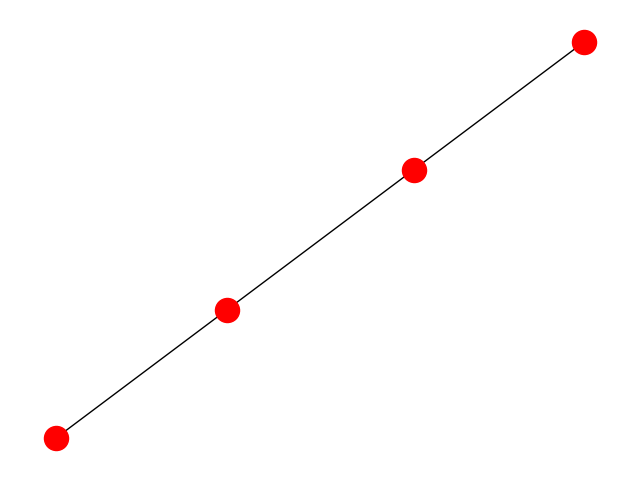
Out:
Add node: foo
Add node: b
Add node: a
Add node: r
Remove node: b
Remove node: a
Remove node: r
[('foo', {'attr_dict': None})]
Add edge: 0-1
[(0, 1, {'attr_dict': None, 'weight': 10})]
Remove edge: 0-1
Add edge: 0-1
Add edge: 1-2
Add edge: 2-3
[(0, 1, {'attr_dict': None, 'weight': 10}), (1, 2, {'attr_dict': None, 'weight': 10}), (2, 3, {'attr_dict': None, 'weight': 10})]
Remove edge: 0-1
Remove edge: 1-2
Remove edge: 2-3
[]
Add edge: 0-1
Add edge: 1-2
Add edge: 2-3
Add edge: 3-4
Add edge: 4-5
Add edge: 5-6
Add edge: 6-7
Add edge: 7-8
Add edge: 8-9
subgraph
Remove node: 4
Remove node: 5
Remove node: 6
Remove node: 7
Remove node: 8
Remove node: 9
[(0, 1), (1, 2), (2, 3)]
[(0, 1), (1, 2), (2, 3)]
# Author: Aric Hagberg (hagberg@lanl.gov)

#    Copyright (C) 2004-2017 by
#    Aric Hagberg <hagberg@lanl.gov>
#    Dan Schult <dschult@colgate.edu>
#    Pieter Swart <swart@lanl.gov>
#    All rights reserved.
#    BSD license.
#
__docformat__ = "restructuredtext en"

from copy import deepcopy

import matplotlib.pyplot as plt
import networkx as nx
from networkx import Graph

class PrintGraph(Graph):
    """
    Example subclass of the Graph class.

    Prints activity log to file or standard output.
    """

    def __init__(self, data=None, name='', file=None, **attr):
        Graph.__init__(self, data=data, name=name, **attr)
        if file is None:
            import sys
            self.fh = sys.stdout
        else:
            self.fh = open(file, 'w')

    def add_node(self, n, attr_dict=None, **attr):
        Graph.add_node(self, n, attr_dict=attr_dict, **attr)
        self.fh.write("Add node: %s\n" % n)

    def add_nodes_from(self, nodes, **attr):
        for n in nodes:
            self.add_node(n, **attr)

    def remove_node(self, n):
        Graph.remove_node(self, n)
        self.fh.write("Remove node: %s\n" % n)

    def remove_nodes_from(self, nodes):
        for n in nodes:
            self.remove_node(n)

    def add_edge(self, u, v, attr_dict=None, **attr):
        Graph.add_edge(self, u, v, attr_dict=attr_dict, **attr)
        self.fh.write("Add edge: %s-%s\n" % (u, v))

    def add_edges_from(self, ebunch, attr_dict=None, **attr):
        for e in ebunch:
            u, v = e[0:2]
            self.add_edge(u, v, attr_dict=attr_dict, **attr)

    def remove_edge(self, u, v):
        Graph.remove_edge(self, u, v)
        self.fh.write("Remove edge: %s-%s\n" % (u, v))

    def remove_edges_from(self, ebunch):
        for e in ebunch:
            u, v = e[0:2]
            self.remove_edge(u, v)

    def clear(self):
        Graph.clear(self)
        self.fh.write("Clear graph\n")

    def subgraph(self, nbunch, copy=True):
        # subgraph is needed here since it can destroy edges in the
        # graph (copy=False) and we want to keep track of all changes.
        #
        # Also for copy=True Graph() uses dictionary assignment for speed
        # Here we use H.add_edge()
        bunch = set(self.nbunch_iter(nbunch))

        if not copy:
            # remove all nodes (and attached edges) not in nbunch
            self.remove_nodes_from([n for n in self if n not in bunch])
            self.name = "Subgraph of (%s)" % (self.name)
            return self
        else:
            # create new graph and copy subgraph into it
            H = self.__class__()
            H.name = "Subgraph of (%s)" % (self.name)
            # add nodes
            H.add_nodes_from(bunch)
            # add edges
            seen = set()
            for u, nbrs in self.adjacency_iter():
                if u in bunch:
                    for v, datadict in nbrs.items():
                        if v in bunch and v not in seen:
                            dd = deepcopy(datadict)
                            H.add_edge(u, v, dd)
                    seen.add(u)
            # copy node and graph attr dicts
            H.node = dict((n, deepcopy(d))
                          for (n, d) in self.node.items() if n in H)
            H.graph = deepcopy(self.graph)
            return H


if __name__ == '__main__':
    G = PrintGraph()
    G.add_node('foo')
    G.add_nodes_from('bar', weight=8)
    G.remove_node('b')
    G.remove_nodes_from('ar')
    print(G.nodes(data=True))
    G.add_edge(0, 1, weight=10)
    print(list(G.edges(data=True)))
    G.remove_edge(0, 1)
    G.add_edges_from(list(zip(list(range(0o3)), list(range(1, 4)))), weight=10)
    print(list(G.edges(data=True)))
    G.remove_edges_from(list(zip(list(range(0o3)), list(range(1, 4)))))
    print(list(G.edges(data=True)))

    G = PrintGraph()
    nx.add_path(G, range(10))
    print("subgraph")
    H1 = G.subgraph(range(4), copy=False)
    H2 = G.subgraph(range(4), copy=False)
    print(list(H1.edges()))
    print(list(H2.edges()))

    nx.draw(G)
    plt.show()
Total running time of the script: ( 0 minutes 0.080 seconds)